Architecture Beyond Earth: Hugh Broughton Architects,
The Martian House and the Logic of Plan R
12/20/20254 min read
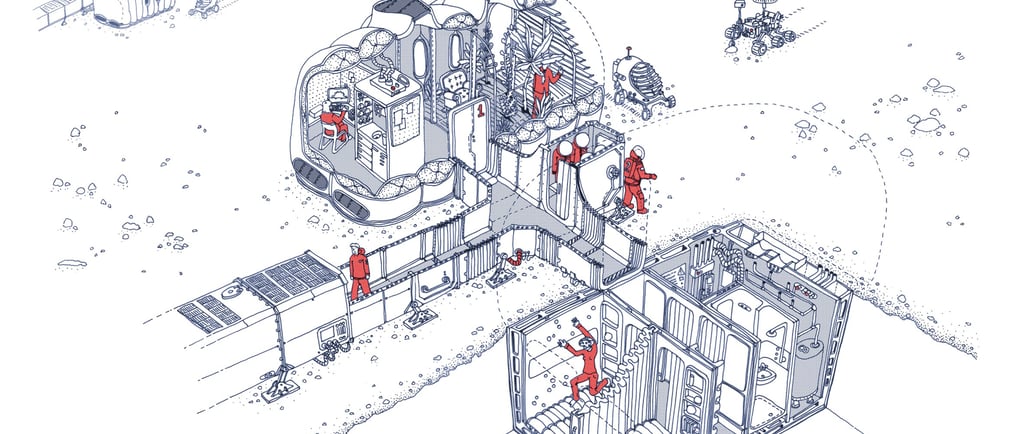
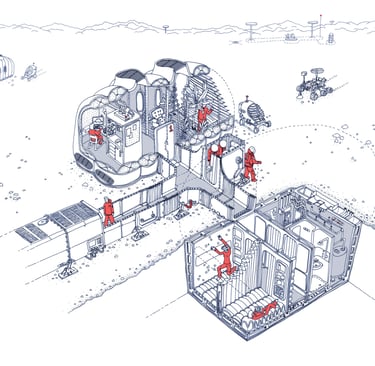
Hugh Broughton Architects (HBA) occupy a rare position within contemporary architectural practice. Their work consistently operates at the threshold of human habitability, where architecture is required not merely to perform socially or aesthetically, but to sustain life itself. From polar research stations to speculative extraterrestrial dwellings, the practice has developed a methodology rooted in environmental realism, systems integration, and an acceptance of architectural constraint as a productive force.
HBA’s reputation was forged through their work in Antarctica, most notably the Halley VI Antarctic Research Station for the British Antarctic Survey. Halley VI is an architecture defined by instability. Located on a moving ice shelf, the station rejects permanence in favour of mobility, modularity, and adaptability. Elevated on hydraulic legs and skis, its modules can be raised above accumulating snow and relocated as the ice fractures beneath them. This approach reframes architecture as a dynamic system rather than a fixed object, responding to environmental change as a core design requirement.
The parallels between Antarctic research stations and off-world habitats are well established. Both exist in environments hostile to human life; both are logistically isolated; both rely on limited resupply windows; and both place significant psychological demands on their occupants. In such contexts, architecture becomes inseparable from engineering, and spatial decisions carry operational consequences. Halley VI demonstrated that extreme habitats must integrate structure, services, circulation, and human comfort into a single, coherent system.
It is from this lineage that HBA’s Martian House emerges—not as a radical departure, but as a logical extension. Developed as a conceptual exploration of habitation on Mars, the Martian House translates lessons learned on Earth into an extraterrestrial context where constraints are intensified rather than transformed.
The Martian environment presents a distinct yet familiar set of challenges: extreme cold, reduced gravity, radiation exposure, dust storms, and total atmospheric hostility. Unlike Antarctica, however, Mars offers no breathable air, no liquid water at the surface, and no possibility of emergency evacuation. Every architectural decision therefore carries existential weight. HBA’s Martian House responds to this reality with restraint and clarity.
Rather than proposing monumental or visually expressive forms, the Martian House is conceived as a compact, pressurised living environment prioritising efficiency, protection, and psychological wellbeing. Its form is driven by performance rather than symbolism. The architecture does not attempt to replicate terrestrial domesticity through superficial means, but instead rethinks domestic space under extraterrestrial constraints.
Radiation protection is a defining concern. On Mars, the absence of a strong magnetic field and a thin atmosphere expose inhabitants to harmful cosmic radiation. HBA’s proposal acknowledges that architectural solutions alone are insufficient; instead, the building must work in concert with environmental strategies such as partial burial or regolith shielding. This recognition aligns the Martian House with a growing consensus in space architecture: that the landscape itself must become part of the protective system.
Internally, the Martian House prioritises spatial clarity and human-centred design. Circulation is legible, private and communal zones are clearly articulated, and daylight—whether real or simulated—is carefully managed. These decisions reflect an understanding that long-duration habitation is as much a psychological challenge as a technical one. Confinement, isolation, and monotony can be as damaging as environmental exposure, and architecture plays a crucial role in mitigating these effects.
This balance between technical necessity and domestic intelligence is where the Martian House becomes particularly relevant to Plan R. Like HBA’s proposal, Plan R begins not with form but with environment. Lava tubes, regolith depth, radiation flux, and thermal inertia are treated as primary architectural inputs. Rather than designing a habitat to sit on the Martian surface, Plan R embeds habitation within geological structures that already offer protection and stability.
Where the Martian House explores a compact, surface-based model of habitation, Plan R extends this thinking into the subsurface, leveraging lava tubes as pre-existing architectural volumes. In both cases, the architecture is secondary to the environment. The building does not dominate the landscape; it negotiates with it.
Importantly, HBA’s Martian House resists the temptation to over-speculate technologically. It does not rely on implausible materials or unproven construction methods. Instead, it extrapolates from existing knowledge—pressurised modules, modular construction, closed-loop life-support systems—mirroring the pragmatic tone of Halley VI. This realism is essential. Space architecture that ignores operational constraints risks becoming illustrative rather than architectural.
Plan R shares this scepticism toward speculative excess. By focusing on passive environmental strategies—radiation shielding through geology, thermal regulation through mass, and spatial efficiency through adaptive reuse of natural voids—it aligns with HBA’s broader philosophy. Both approaches understand that sustainability in extreme environments is achieved not through technological escalation, but through intelligent reduction.
Another critical connection lies in the scalability of HBA’s methodology. The Martian House, though speculative, is not conceived as a singular object but as part of a broader system of habitation. Its modular logic suggests the potential for aggregation, adaptation, and phased expansion—qualities essential for any credible extraterrestrial settlement. Plan R similarly treats habitation as an evolving system rather than a finished artefact, capable of responding to changing needs, populations, and resource availability.
What HBA’s work ultimately demonstrates—across polar stations, the Martian House, and their wider research—is that extreme habitat design demands a redefinition of architectural authorship. The architect becomes less a form-giver and more a systems integrator, negotiating between environment, engineering, and human experience. This shift is particularly relevant to the space industry, where architecture must operate within multidisciplinary teams and under unprecedented constraints.
The space sector presents architects with a fundamental challenge: how to design when maintenance is remote, failure is catastrophic, and resources are finite. HBA’s response is not to retreat into engineering determinism, but to assert the value of architectural thinking within these limits. Spatial quality, orientation, material logic, and human comfort remain essential—even when every gram and cubic metre is scrutinised.
In this context, the Martian House functions less as a vision of a specific future dwelling and more as a conceptual bridge. It connects terrestrial extreme environments with extraterrestrial ones, and operational architecture with speculative research. It demonstrates that space architecture does not emerge from science fiction, but from the disciplined extension of proven methodologies into new contexts.
Plan R stands firmly within this lineage. Like HBA’s work, it treats extreme environments not as blank canvases but as active participants in the design process. By embedding habitation into lava tubes, Plan R pushes the logic of environmental integration further, proposing a model of space architecture rooted in geology rather than objecthood.
Together, HBA’s Martian House and Plan R suggest a future for space architecture that is cautious, intelligent, and profoundly architectural—not because it looks futuristic, but because it understands what architecture must become when survival is the primary brief.