NASA - Blueprint for an Enduring Lunar Presence
Plan R: A Critique of Surface-First Lunar Architecture
6/2/20264 min read
An Opportunity NASA May Be Overlooking
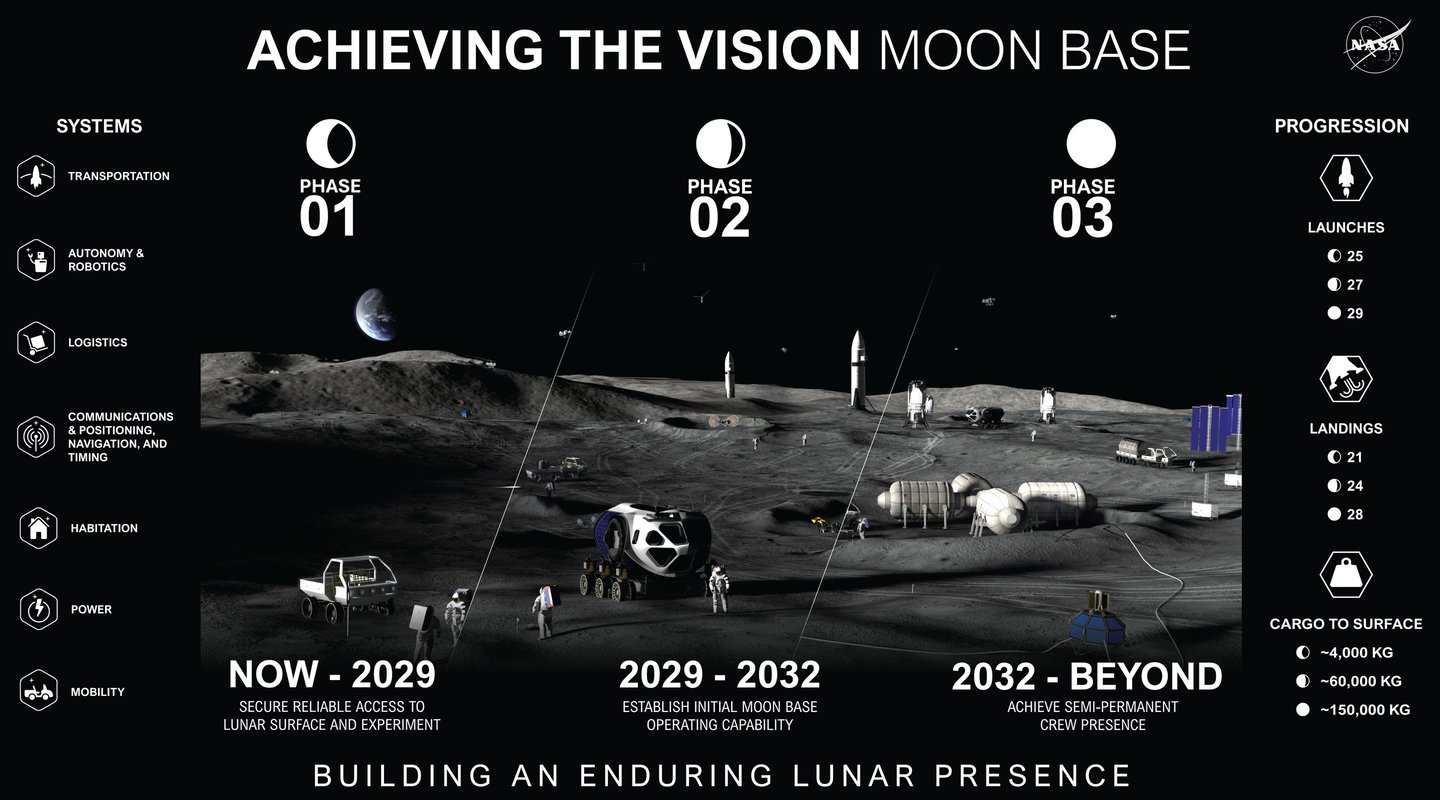
As NASA’s Moon Base Phases initiative outlines the next era of human lunar exploration, one thing becomes immediately clear:
The engineering ambition is extraordinary.
Robotic precursor missions, autonomous systems, surface infrastructure, power grids, mobility platforms, and long-duration habitation strategies all point toward a serious commitment to permanent human presence beyond Earth.
But buried within this vision is a critical architectural assumption that deserves scrutiny.
NASA still appears overwhelmingly focused on building on the Moon rather than building with the Moon.
That distinction may define the difference between sustainable settlement and permanently expensive survival.
The Surface Is the Wrong Starting Point
Much of the current lunar architecture emerging from agencies and contractors continues to treat the lunar surface as the primary site of occupation.
Habitats are imagined as engineered objects placed into one of the harshest environments in the solar system:
exposed to radiation
exposed to micrometeorites
exposed to thermal extremes
exposed to electrostatic dust
exposed to violent temperature cycling
The result is predictable.
Every environmental threat demands another engineered solution:
radiation requires shielding
shielding increases mass
mass increases launch costs
launch costs increase infrastructure demand
infrastructure demand increases power consumption
power consumption increases system complexity
The architecture becomes an escalating logistical burden simply to resist the environment.
This raises an uncomfortable question:
Why are we insisting on occupying the most hostile part of the Moon when the Moon may already contain naturally protected environments?
The Missed Opportunity: Lunar Lava Tubes
For decades, orbital observations from NASA, Japan Aerospace Exploration Agency, and other institutions have identified evidence of enormous lunar lava tubes.
These are not small caves.
Some may extend for kilometres beneath the lunar surface.
Importantly, they already provide many of the conditions NASA is attempting to engineer artificially:
radiation protection
thermal stability
micrometeorite shielding
environmental buffering
structural enclosure
These are some of the largest engineering problems in lunar habitation.
Yet subsurface habitation still appears secondary in many architectural visions.
This may represent one of the single greatest missed opportunities in contemporary space architecture.
Mass Is the Real Problem
Most lunar architecture discussions still frame habitation as a structural challenge.
In reality, it is a mass challenge.
Every kilogram launched from Earth carries enormous economic and operational consequences.
This is where current approaches begin to look increasingly inefficient.
Large rigid habitat systems require:
heavy shielding
rigid structural frames
deployment systems
surface stabilisation
thermal protection layers
redundant environmental systems
All of this mass is transported simply to recreate conditions that geology may already provide naturally underground.
The Moon itself is being treated as an obstacle rather than an asset.
Plan R: A Geology-First Alternative
Plan R proposes a fundamentally different approach:
Use geology as infrastructure.
Instead of transporting massive protective shells to the lunar surface, the architecture adapts itself to naturally protected lava tube environments.
The research focuses on:
low-power reconnaissance
cave scanning
inflatable habitat systems
lightweight mesh structures
adaptive internal membranes
low-mass deployment strategies
Rather than constructing rigid buildings inside caves, the system proposes flexible inflatable structures capable of conforming directly to geological geometry.
The cave becomes the primary protective shell.
The architecture becomes a lightweight environmental lining.
This dramatically changes the mass equation.
The Wrong Direction of Complexity
One of the concerns emerging from NASA’s current trajectory is the increasing complexity of proposed infrastructure.
The Moon Base roadmap describes:
large surface systems
expanding logistics networks
distributed infrastructure
autonomous construction platforms
heavy deployment sequences
But complexity is expensive.
Complexity consumes:
power
bandwidth
maintenance
redundancy
launch capacity
operational time
Extraterrestrial environments punish complexity.
Plan R instead argues for reduction:
lower mass
lower power
lower data requirements
adaptive geometry
environmental integration
The question should not be:
“How do we build more machinery to survive the Moon?”
The question should be:
“How much of the survival problem has the Moon already solved for us?”
Scanning Before Occupation
Another overlooked issue within many lunar concepts is environmental understanding.
NASA openly acknowledges how little is truly known about the lunar surface and subsurface environments. Yet much of the architectural thinking still assumes occupation before comprehensive environmental intelligence exists.
Plan R begins from the opposite direction.
The first stage is reconnaissance.
Using lightweight systems such as:
Low power LiDAR scanning with data appropriate fidelity
Data reconstruction workflows
3d environment reconstruction with AI interpretation
simplified geometry processing
low-bandwidth digital models
the project explores how lava tubes can be understood through minimal-energy survey systems.
This becomes increasingly important in lunar conditions where:
communication bandwidth is limited
processing power is constrained
robotic systems must operate autonomously
energy budgets remain extremely tight
The goal is not maximum fidelity.
The goal is operational understanding.
Less data.
More relevance.
Iceland as a Lunar Analogue
Field investigations at Leiðarendi Lava Cave in Iceland reinforced the importance of subsurface environments.
On the surface:
high winds
rain
cold exposure
unstable conditions
Inside the lava tube:
thermal stability
calm air
dryness
environmental stillness
The transition was immediate.
The cave itself was already performing environmental regulation without:
power systems
structural shielding
active climate control
maintenance infrastructure
The geology was doing the work.
This is precisely the opportunity lunar architecture risks underestimating.
Inflatable Systems and Adaptive Occupation
Plan R also challenges another assumption embedded in many current space habitat concepts: rigid modularity.
Lava tubes are irregular.
No two environments will be identical.
Rigid repeatable modules may therefore be fundamentally mismatched to subsurface occupation.
The proposed mesh–inflatable habitat system instead uses:
flexible structural netting
inflatable pressure membranes
geometry-driven expansion
polymer rigidification systems
The architecture adapts to the cave rather than forcing the cave to adapt to the architecture.
This is not merely lighter.
It is operationally smarter.
The Real Opportunity for NASA
The opportunity is not simply building lunar bases.
The opportunity is redefining how architecture operates beyond Earth.
Current surface-first thinking risks repeating terrestrial construction logic in an environment where those assumptions may no longer make sense.
Lava tubes offer:
protection
stability
enclosure
insulation
structural shelter
Ignoring them as primary habitation systems may prove to be one of the most expensive architectural oversights in the history of exploration.
NASA’s greatest challenge may not be engineering larger systems.
It may be recognising when the environment itself is already the system.
Plan R argues that the future of lunar habitation may depend less on constructing ever more massive infrastructure on the surface, and more on learning how to occupy the spaces the Moon has already built for us.
Image Credit: NASA/Edmy S. Cruz Reyes