Plan R: Apollo 15 at Hadley Rille
The First Real Clue to Lunar Subsurface Habitats
6/10/20263 min read
The First Real Clue to Lunar Subsurface Habitats
Plan R starts with a simple assumption:
The Moon is not a surface problem. It is a subsurface opportunity.
Apollo 15, at Hadley Rille in 1971, didn’t confirm that assumption—but it produced the first field-scale evidence that makes it plausible.
Not by finding a cave.
But by standing at the edge of the system that creates them.
What Apollo 15 actually saw
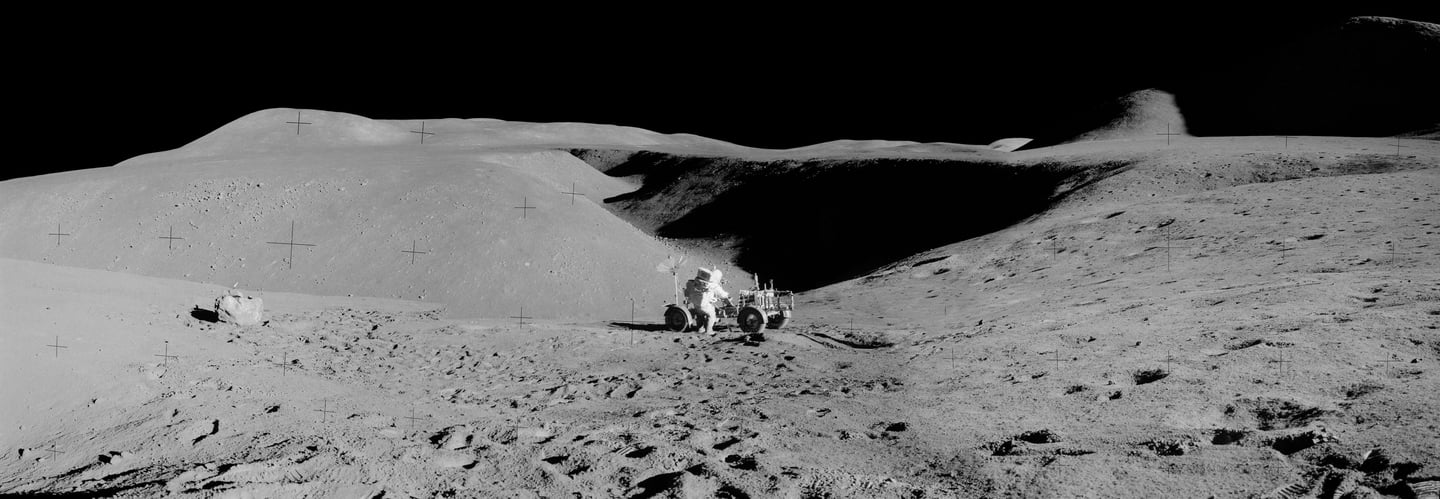
At Hadley–Apennine, astronauts David Scott and James Irwin explored the rim of a vast sinuous channel cutting through lunar basalt: Hadley Rille.
What they observed was not subtle:
A canyon-like structure over 100 km long
Exposed layers of stacked basalt flows in the rille walls
Terraced structure consistent with repeated volcanic deposition
A morphology incompatible with simple tectonic faulting
This was not a fracture. It was not random collapse.
It was the exposed architecture of a lunar lava transport system.
What it was interpreted as
Post-mission analysis converged on a volcanic origin:
A sinuous rille formed by highly fluid basaltic lava
Likely involving thermal erosion and sustained lava flow
Potentially influenced by partial roof collapse in earlier phases
Importantly, multiple mechanisms may overlap. Hadley Rille is not a clean textbook structure—it is a hybrid record of volcanic plumbing exposed at the surface.
What it is not is just as important:
Not a confirmed intact lava tube
Not a tectonic graben
Not a simple impact feature
It sits in a more operationally interesting category:
A broken open section of a system that could have produced lava tubes elsewhere.
Why Plan R cares about this
Plan R is not interested in lunar geology as classification. It is interested in lunar geology as infrastructure logic.
Hadley Rille matters because it proves four things:
The Moon produced high-volume, long-duration basalt flows
Those flows behaved in ways that are consistent with tube-forming lava systems
The structural conditions for large subsurface voids definitely existed
We can read those systems directly from exposed terrain
In engineering terms:
Apollo 15 did not find usable voids. It validated the fabrication environment that produces them.
What modern orbital data adds
The next step in the chain comes from orbital reconnaissance, particularly the Lunar Reconnaissance Orbiter.
Unlike Apollo 15, which was constrained to a single field site, orbital datasets now suggest a distributed pattern:
Skylight openings in volcanic regions
Pit craters consistent with roof collapse
Radar and thermal anomalies suggesting subsurface voids
Repeating morphological signatures across mare provinces
These features are no longer isolated curiosities. They form a candidate network of subsurface structures.
Plan R interprets this as a shift in design space:
From surface settlement to subsurface architecture selection.
Apollo 15 as the missing calibration point
Hadley Rille is not a habitat candidate.
It is the calibration reference.
It provides:
Ground-truth morphology of a large lunar lava system
Real stratigraphy of mare basalt accumulation
A constraint set for how far lunar lava systems can scale
A visual model for what collapsed or open conduits look like at human scale
Without Apollo 15, orbital data would be speculative.
Without orbital data, Apollo 15 would be isolated.
Together, they define a coherent system.
What this means for Plan R
Plan R reframes the entire lava tube question:
Not:
“Do lunar lava tubes exist?”
But:
“Where does the system suggest they are stable, accessible, and useful?”
This shifts the problem from geology into selection criteria:
structural stability over geologic time
entrance accessibility (skylights, pits, collapses)
proximity to resources (ice, regolith diversity, solar access trade-offs)
internal volume sufficient for habitat-scale infrastructure
In that framework:
Apollo 15 defines the system behaviour
LRO defines the candidate locations
Plan R defines the selection logic
Closing
Apollo 15 did not deliver a cave.
It delivered something more important for Plan R:
A real-world exposure of the system that makes caves inevitable.
Hadley Rille is not the destination.
It is the proof that the destination should exist.
And everything now depends on finding where it is still intact.
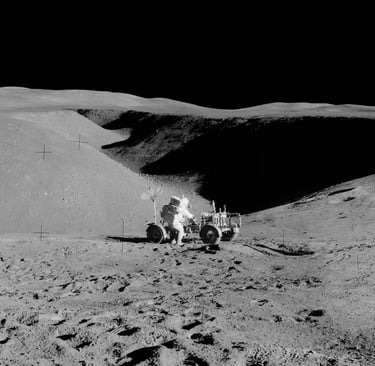
Apollo 15 astronaut Dave Scott and the Lunar Rover with a view up Hadley Rille in the background. Credit: NASA via Retro Space Images