Research Project .Alpha.
ScannerVerse, Blender Workflows, Low-Power Lunar Surveying, and Inflatable Habitat Prototyping
Research Project Alpha
Site Investigation: Leiðarendi Lava Cave, Icelands
Lava Tube Exploration, Environmental Analysis, and the Potential for Low-Power Planetary Scanning Systems
Introduction
Research Project Alpha forms part of an ongoing investigation into extraterrestrial habitat design and the architectural opportunities presented by lava tube environments on the Moon and Mars. The project seeks to understand how naturally occurring geological voids may provide protection, environmental stability, and long-term viability for future human habitation beyond Earth.
As part of this research, a detailed site visit was undertaken to Leiðarendi Lava Cave in Iceland. Iceland provides one of the closest terrestrial analogues for extraterrestrial volcanic landscapes due to its active geology, basaltic terrain, lava fields, and extensive cave systems formed through volcanic activity. While no Earth-based environment can fully replicate lunar or Martian conditions, lava tubes in Iceland allow direct investigation into the spatial, geological, and environmental characteristics of subterranean volcanic formations.
The purpose of the expedition was not simply exploration, but the physical assessment of lava tube environments as potential analogues for future extraterrestrial habitation systems. Particular focus was placed on:
Environmental transition between surface and subsurface conditions
Spatial geometry and structural characteristics of lava tubes
Thermal and atmospheric stability within the cave
Human movement and perception within confined geological spaces
The use of consumer-grade scanning technology to digitally record cave environments
The potential development of lightweight planetary survey systems derived from smartphone LiDAR technologies
The visit also acted as an architectural exercise in understanding how humans psychologically experience underground environments and how these spaces may support future habitation systems on the Moon or Mars.
Leiðarendi Lava Cave
Leiðarendi Lava Cave is located within the volcanic landscapes of southwest Iceland, formed through ancient lava flows that created hollow subterranean channels beneath cooling basalt crusts. These formations occur when the outer layer of a lava flow cools and solidifies while molten lava continues moving internally. Once the flow ceases, a void remains beneath the hardened surface.
The resulting cave system is irregular, unpredictable, and highly geological in character. Unlike conventional architecture, the lava tube possesses no formal order, orthogonal geometry, or intentional spatial hierarchy. Instead, the environment is defined by fractured basalt, compressed circulation routes, shifting ceiling heights, and naturally formed chambers.
This irregularity is precisely what makes lava tubes compelling as extraterrestrial analogues. Rather than constructing entirely artificial habitats on hostile planetary surfaces, future settlement strategies may instead adapt and occupy existing geological formations.
Such an approach fundamentally changes the architectural question.
The challenge becomes less about building objects upon a landscape and more about understanding how habitation can emerge within a pre-existing geological condition.
This distinction is central to Research Project Alpha.
Surface Conditions: Exposure and Environmental Hostility
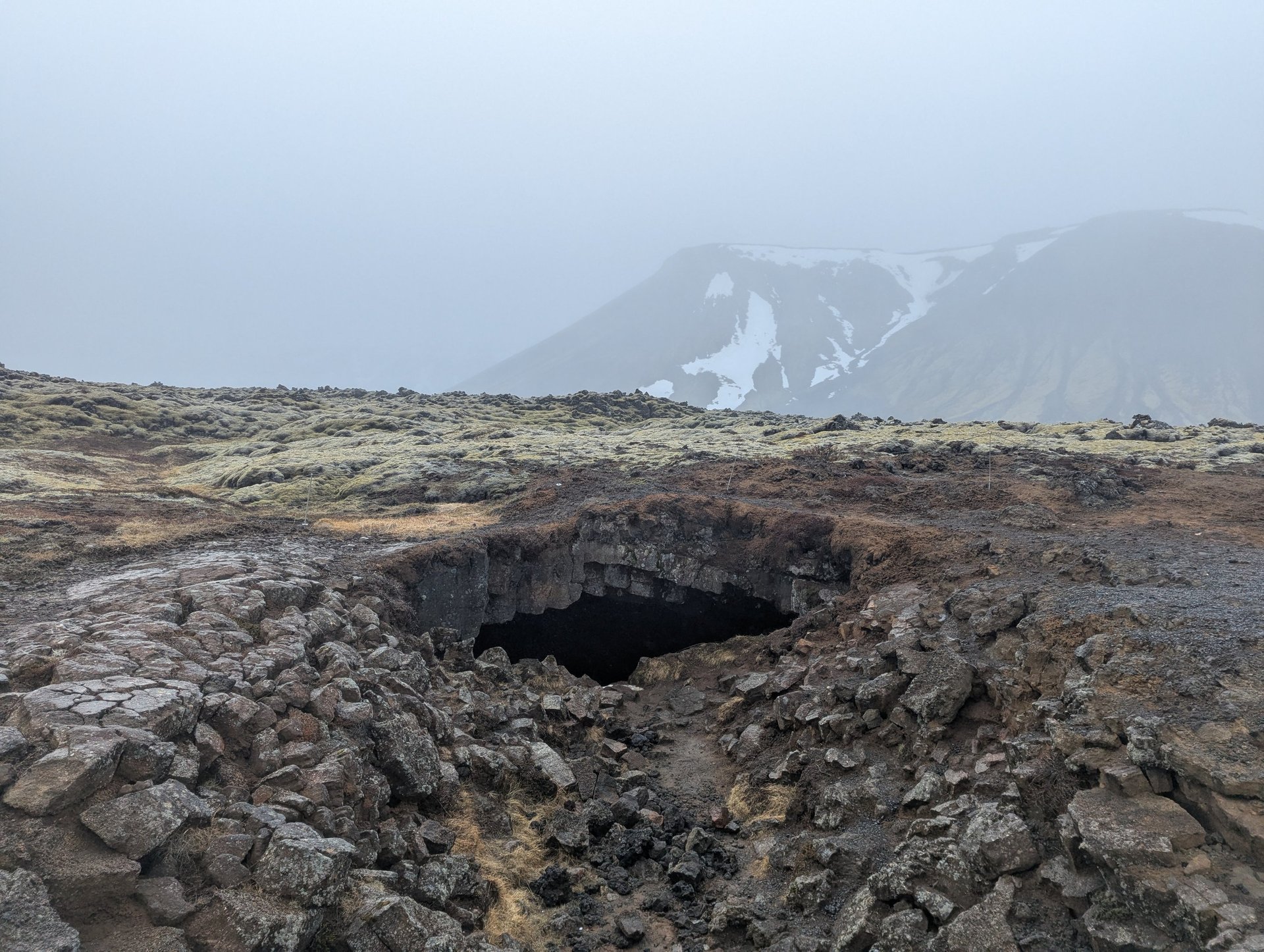
The approach to Leiðarendi immediately demonstrated the harshness of exposed volcanic terrain.
Weather conditions during the site visit were extreme. High winds swept across the open lava fields with little resistance due to the absence of vegetation or topographical shelter. Rain moved horizontally across the landscape, driven by sustained wind exposure. Ambient temperatures remained low, and surface conditions felt unstable, exposed, and environmentally hostile.
The volcanic terrain itself intensified this sensation. The lava fields were sharp, uneven, porous, and visually monochromatic, producing a landscape that felt simultaneously ancient and alien. Traversing the site required constant physical awareness and careful movement across fractured basalt surfaces.
The environment carried many characteristics commonly associated with conceptual representations of Mars:
Minimal vegetation
Exposed geological terrain
Harsh climatic conditions
Isolation and silence
Monochromatic landscapes
Limited visual reference points
Psychological exposure
Although Earth maintains breathable atmosphere and biological life, the emotional and spatial experience of the landscape hinted at what extraterrestrial surface environments may feel like psychologically.
On the surface, the body is continuously subjected to environmental instability.
Wind, rain, cold, and exposure dominate the experience.
This condition becomes particularly relevant when considering extraterrestrial architecture. Any habitat constructed directly on the surface of Mars or the Moon would face constant environmental pressures:
Radiation exposure
Micrometeorite impacts
Thermal extremes
Dust storms
Vacuum conditions
Solar exposure
Structural pressurisation requirements
Surface architecture in space therefore demands enormous technological complexity simply to maintain survivable internal conditions.
The Icelandic landscape revealed how fundamentally vulnerable exposed habitation systems may become.
Transition into the Cave
The most significant moment of the site visit occurred during the transition from surface to subsurface environment.
Entry into the lava cave produced an immediate environmental shift.
Within moments of descending below the surface, the extreme external conditions disappeared almost entirely.
The wind vanished.
Rain ceased.
Temperatures stabilised.
The atmosphere became calm, still, and unexpectedly comfortable.
Despite the hostile conditions above ground, the cave interior felt sheltered, thermally stable, and psychologically protected. The geological mass surrounding the lava tube acted as a natural environmental buffer.
This transition represents one of the most important observations of the entire study.
The lava cave was not merely a void beneath the landscape; it functioned as a naturally occurring environmental protection system.
The surrounding basalt moderated climatic instability and created conditions fundamentally different from those above.
This phenomenon has profound implications for lunar and Martian habitation.
Much of the engineering challenge associated with extraterrestrial settlement stems from the need to artificially recreate stable environments on exposed planetary surfaces. Lava tubes suggest an alternative strategy:
Use geology itself as infrastructure.
Rather than resisting planetary conditions through increasingly complex technological systems, habitation could instead occupy environments where protection already exists naturally.
On Mars and the Moon, lava tubes may provide:
Radiation shielding
Thermal stability
Micrometeorite protection
Reduced structural exposure
Dust storm protection
Energy efficiency
Long-term environmental consistency
The experience within Leiðarendi transformed these ideas from abstract theory into physical reality.
The cave demonstrated, at human scale, how geological mass fundamentally alters environmental behaviour.
Spatial Experience and Human Psychology
One of the most valuable aspects of the site visit was the opportunity to physically experience spatial movement within a lava tube.
Architectural drawings and digital models cannot fully communicate the psychological conditions produced by geological environments.
The cave constantly shifted between compression and expansion.
Some sections required crouching or careful movement through narrow passages, while others opened into unexpectedly large chambers. Ceiling heights varied unpredictably. Light conditions changed continuously. Surfaces absorbed sound and altered spatial perception.
This created an environment that was simultaneously protective and psychologically intense.
The cave generated a heightened awareness of scale, orientation, and bodily movement.
Future extraterrestrial habitats embedded within lava tubes will need to address these psychological conditions carefully. While geological shelter offers enormous environmental advantages, underground habitation may also create challenges relating to:
Claustrophobia
Isolation
Circadian rhythm disruption
Spatial monotony
Psychological confinement
Loss of visual connection to external environments
The site visit therefore reinforced the importance of architecture within geological habitats.
The lava tube alone is not the habitat.
Rather, the cave becomes the environmental container within which architecture must operate.
Future habitation systems may need to introduce:
Artificial daylight cycles
Controlled visual openness
Flexible spatial programming
Acoustic management
Communal and private zones
Psychological orientation systems
Carefully designed circulation paths
Research Project Alpha considers the architectural role to be one of mediation between human psychology and geological reality.
The cave provides protection.
Architecture provides habitability.
Digital Surveying and iPhone LiDAR Scanning
A significant component of the site investigation involved testing the capabilities of consumer-grade scanning technology within subterranean volcanic environments.
Using the LiDAR scanning capabilities integrated within modern iPhone devices, sections of the cave were digitally surveyed and spatially recorded.
The results were remarkable.
Despite operating in difficult lighting conditions and irregular geological environments, the device was capable of generating accurate three-dimensional spatial information in real time. Surfaces, voids, ceiling geometries, circulation routes, and volumetric conditions could all be rapidly captured using a handheld device small enough to fit within a pocket.
Historically, geological surveys of cave systems required specialised equipment, extensive logistical support, and highly trained operators. The emergence of consumer-level LiDAR technology fundamentally changes accessibility to spatial data collection.
Several important observations emerged from the scanning process:
1. Speed of Capture
Large quantities of spatial information could be collected rapidly while moving through the cave environment.
2. Portability
The scanning system required minimal equipment and operated without significant setup time.
3. Accessibility
The technology reduced barriers between exploration and digital documentation.
4. Real-Time Feedback
Spatial geometry could be visualised immediately during the survey process.
5. Low Energy Consumption
Compared to traditional scanning systems, smartphone-based LiDAR technologies operate with relatively low power requirements.
This final point became particularly important within the context of extraterrestrial exploration.
Towards a Low-Power Planetary Scanning System
The success of the iPhone-based scanning tests led to broader theoretical discussions surrounding planetary exploration technologies.
Research Project Alpha proposes the concept of a lightweight micro-satellite or robotic exploration mission utilising low-power LiDAR systems derived from consumer smartphone technology.
The concept emerges from a simple observation:
If a handheld consumer device can effectively map complex subterranean environments on Earth, could similar systems be adapted for autonomous extraterrestrial surveying?
Current planetary missions often rely upon highly specialised, expensive, and energy-intensive scanning equipment. While highly capable, these systems create limitations relating to:
Launch mass
Energy consumption
Mission cost
Complexity
Scalability
By contrast, smartphone LiDAR systems demonstrate how compact, low-energy sensing technologies can perform sophisticated spatial analysis using relatively small hardware platforms.
Research Project Alpha suggests that future exploration strategies may benefit from distributed networks of lightweight scanning systems rather than singular large-scale missions.
Potential mission concepts could include:
Micro-rovers designed to enter lava tubes
Autonomous mapping drones
Swarm-based scanning systems
CubeSat-supported communication networks
Portable environmental scanning units
Robotic precursor missions for habitat assessment
The primary objective would be the identification and assessment of subsurface geological environments suitable for future human occupation.
Lava tubes on the Moon and Mars remain largely unexplored.
Orbital imagery suggests the existence of enormous subterranean voids, some potentially vast enough to contain entire urban districts. However, very little direct spatial data exists regarding their internal conditions.
Future settlement strategies may therefore depend upon robotic surveying systems capable of entering and mapping these environments before human arrival.
A low-power scanning platform based on miniaturised LiDAR technologies could provide several advantages:
Reduced launch costs
Lower energy demands
Increased mission redundancy
Scalable deployment
Faster environmental assessment
Distributed data collection
Greater operational flexibility
This line of investigation opens an entirely new stream of study within Research Project Alpha.
The habitat itself may only represent one component of future extraterrestrial architecture.
Equally important may be the systems used to discover, analyse, and understand the geological environments in which those habitats will eventually exist.
Lava Tubes as Planetary Infrastructure
The site visit to Leiðarendi reinforced the idea that lava tubes should not be viewed simply as shelters.
They may instead represent planetary infrastructure.
On Earth, architecture typically creates protection artificially through walls, roofs, insulation, and environmental systems. In extraterrestrial environments, however, constructing equivalent protection externally would require enormous quantities of material, energy, and logistical support.
Lava tubes fundamentally alter this equation.
The geological environment already performs many critical protective functions passively.
This changes the architectural strategy from one of total construction to one of adaptive occupation.
Future habitats may therefore operate more like insertions within existing geological systems rather than isolated standalone buildings.
Research Project Alpha explores how this shift could redefine architecture itself.
Instead of architecture existing as an object placed upon a landscape, architecture may become an interface between human systems and geological systems.
This approach introduces several advantages:
Reduced structural exposure
Lower material requirements
Improved thermal performance
Increased radiation protection
Greater long-term resilience
Potential for scalable settlement growth
Importantly, the Icelandic cave demonstrated that these advantages are not purely theoretical.
The environmental contrast between surface and subsurface conditions was immediate and undeniable.
Architecture, Exploration, and the Future
The site investigation at Leiðarendi Lava Cave represented more than geological exploration.
It functioned as a direct architectural experiment.
The experience demonstrated how environmental hostility can be transformed through geological shelter, how spatial psychology changes underground, and how lightweight digital technologies may support future exploration and habitation systems.
The use of iPhone LiDAR scanning also revealed the growing convergence between consumer technology and advanced spatial research. Tools once restricted to specialist industries are becoming increasingly accessible, portable, and adaptable.
This democratisation of scanning technology may prove significant for the future of planetary exploration.
Just as smartphones transformed communication and photography, low-power spatial sensing systems may transform how environments are mapped, understood, and occupied.
Research Project Alpha therefore extends beyond architecture alone.
It investigates the relationship between geology, habitation, robotics, sensing technologies, and planetary exploration.
The project proposes that future extraterrestrial settlements will not emerge solely through monumental engineering projects, but through intelligent integration between natural environments and lightweight technological systems.
The lessons learned within a lava cave in Iceland may ultimately contribute to how humanity first inhabits the Moon and Mars.
Conclusion
The visit to Leiðarendi Lava Cave provided a rare opportunity to physically experience a geological environment analogous to those that may one day support human life beyond Earth.
The contrast between the hostile surface environment and the calm, stable interior of the cave demonstrated the enormous potential of lava tubes as natural protective systems.
Equally important was the realisation that emerging consumer technologies — particularly lightweight LiDAR scanning systems — may play a critical role in future planetary exploration.
Research Project Alpha positions these two investigations together:
The architectural potential of lava tube habitats
The technological systems required to discover and analyse them
Together they form a broader vision of future habitation based not on domination of hostile environments, but on intelligent adaptation to them.
The cave in Iceland was not simply a destination.
It was a prototype of another world.
And within its darkness, calmness, and geological shelter lay a possible model for the future of human habitation beyond Earth.
Explore Space Living
Subscribe for updates on extraterrestrial habitat innovations